
Prosthetic arms are artificial limbs designed to restore function and improve the quality of life for individuals who have lost an arm due to injury, illness, or other circumstances. Whether you’re an adult needing a prosthetic limb or a parent researching options for your child, understanding how these devices are attached to the body is key to making informed decisions.
How is a prosthetic arm attached?
The way a prosthetic arm attaches to the body depends on the residual limb—the remaining portion of the arm after amputation—and the type of prosthetic chosen.
Several methods are commonly used:
- Suspension systems: These involve straps or sleeves that wrap around the residual limb to hold the prosthetic arm in place. They’re adjustable and widely used for their simplicity.
- Suction sockets: This method uses a vacuum seal between the prosthetic and the residual limb, ensuring a snug fit that stays secure during movement.
- Osseointegration: A surgical procedure implants a metal piece into the bone of the residual limb. The prosthetic arm then attaches directly to this implant, offering a stable connection.
The best method varies based on factors like the amputation level (e.g., upper arm or shoulder disarticulation), the condition of the residual limb, and your daily needs. A professional orthotist can help determine the right approach for you or your child.
How are prosthetics secured?
Keeping a prosthetic arm in place during use is critical for comfort and functionality.
Here are the main ways prosthetics are secured:
- Straps and harnesses: Often used for upper arm amputations or shoulder disarticulation, these provide a reliable hold, especially for active users.
- Suction: Suction sockets rely on a tight seal with the residual limb, preventing slippage without the need for straps.
- Liners: Soft, cushioned liners worn over the residual limb enhance comfort and help secure the prosthetic.
- Locking mechanisms: Some designs use pins or locks to connect the prosthetic to the residual limb, offering extra stability.
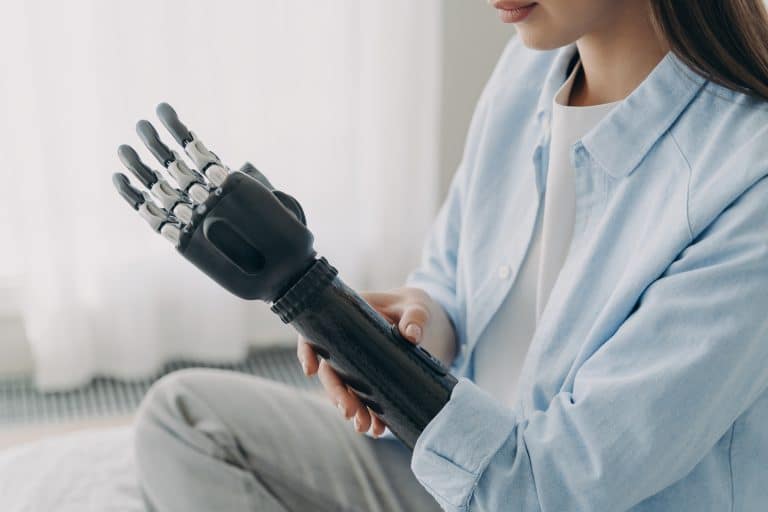
The securing method depends on the type of prosthetic. For instance, myoelectric prostheses, which rely on electrical signals to move a prosthetic hand, might use a combination of suction and liners for a secure fit tailored to muscle movement.
How do prosthetic arms connect to nerves?
Advanced prosthetic arms can connect to the body’s nerves or muscles for more natural control. Myoelectric prostheses are a prime example. These devices use sensors to detect electrical signals generated by muscle contractions in the residual limb. When you think about moving your arm, the muscles activate, and the prosthetic translates those signals into actions, like opening or closing a prosthetic hand.
Another technique, called targeted muscle reinnervation, involves a surgical procedure to redirect nerves from the amputated arm to nearby muscles (often in the chest). This allows the prosthetic to pick up nerve signals through muscle activity, offering precise control and even some sensory feedback. These innovations make tasks easier and boost quality of life by mimicking natural movement.
Are prosthetics surgically attached?
Most prosthetic arms are not surgically attached. Non-surgical options like suspension systems, suction, or straps are the norm, making them easier to adjust or remove. However, osseointegration—a surgical procedure—is an exception. It involves inserting a metal implant into the residual limb’s bone, to which the prosthetic attaches directly. This method suits active individuals or those struggling with traditional prosthetic fits, providing a firm, long-lasting connection. Still, it’s not for everyone and requires a medical evaluation to ensure it’s a safe choice.
Trusted Orthotists at Pongratz
Our comprehensive and professional services will ensure your orthotics and prosthetic limbs are always in optimal condition.
If you or your loved one requires a professional orthotist, consider consulting with Pongratz. We promise that our care utilizes the latest advancements in orthotic and prosthetic technology. We will ensure your needs are met and that you are on the path to healthy foot, ankle, and back development.
Our team of specialists in Avondale, Chandler, Gilbert/Mesa, Phoenix, Glendale, Scottsdale, and Tucson would love to help you.