
Prosthetic arms are artificial limbs designed to help individuals regain function and improve their quality of life after losing an arm. Whether you’re an adult adapting to limb loss or a parent seeking solutions for your child, understanding how these prosthetic devices work can ease the transition.
How do prosthetic arms know what to do?
Prosthetic arms respond to user input through different control methods, depending on the type of prosthesis:
- Passive prosthetics: These focus on appearance and provide minimal function, like aiding balance.
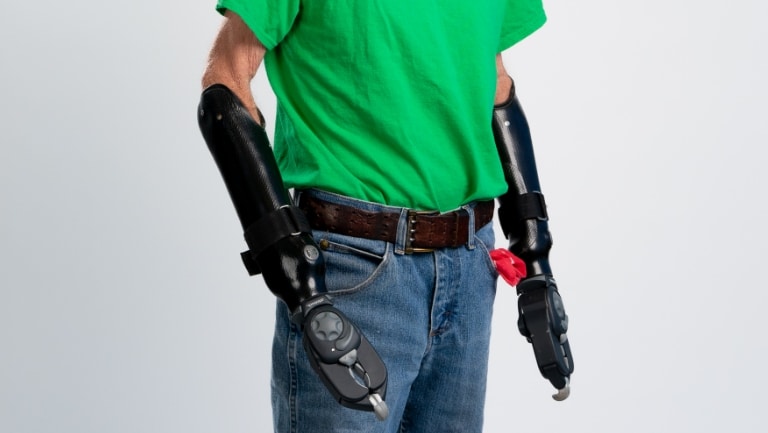
- Body-powered prosthetics: Using cables and harnesses, they rely on body movements—such as shrugging a shoulder—to open or close the prosthetic hand.
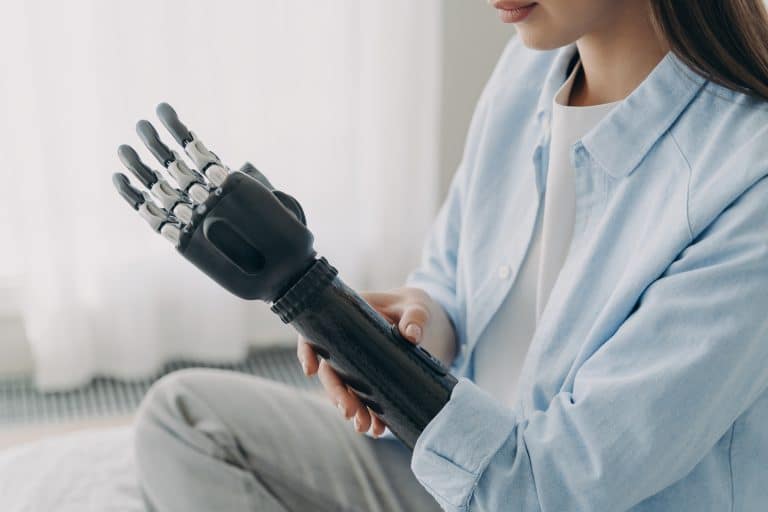
- Myoelectric prosthetics: These advanced devices detect electrical signals from muscle contractions in the residual limb. When you flex specific muscles, sensors translate those signals into movements, like gripping with the prosthetic hand.
Myoelectric prosthetics offer intuitive control, making them a popular choice for upper limb prosthetics. With practice, users can perform everyday tasks naturally.
How do prosthetic arms stay on?
Securing a prosthetic arm to the body involves several methods tailored to individual needs:
- Suspension systems: Straps or sleeves wrap around the residual limb or torso for stability.
- Suction sockets: A tight-fitting socket forms a vacuum seal with the residual limb, keeping the prosthetic in place.
- Osseointegration: A surgical implant anchors the prosthetic directly to the bone, offering a firm connection for specific cases.
Your orthotist will recommend the best option based on your amputation level and lifestyle, ensuring a reliable fit.
How do people with prosthetic arms move their fingers?
Finger movement in a prosthetic hand is often enabled by myoelectric prosthetics. Sensors on the residual limb pick up muscle contractions, which a microprocessor converts into actions like opening and closing the hand. Advanced bionic hands can even move individual fingers, providing dexterity for tasks like picking up small objects or typing. While simpler models may only open and close as a unit, they still support many daily activities.
Can you control a prosthetic arm with your brain?
Currently, most prosthetic limbs rely on muscle signals for control. However, advancing prosthetics include experimental brain-computer interfaces (BCIs), which aim to let users control prosthetics with their thoughts. BCIs detect brain activity and translate it into commands, but this technology is still in development and not widely available. For now, myoelectric prosthetics remain the most practical and accessible solution.
Can prosthetic arms get wet?
Some prosthetic arms are water-resistant or waterproof, suitable for activities like swimming or showering. However, it depends on the design—especially for myoelectric prosthetics with electronic components. Always consult your orthotist or manufacturer for care instructions to protect your prosthetic and ensure its long-term use.
What is the life expectancy of a prosthetic arm?
A prosthetic arm typically lasts 3-5 years, though this varies with usage, maintenance, and wear on parts like the prosthetic hand. Regular check-ups with an orthotist can extend the lifespan. As technology evolves, you might also consider upgrading to a newer bionic arm for improved features.
Are prosthetic arms uncomfortable?
A properly fitted prosthetic arm should feel comfortable for daily use. However, challenges like skin irritation from socket friction or improper prosthetic fits can arise. Professional adjustments, cushioned liners, and lightweight materials help minimize discomfort, ensuring your prosthetic enhances rather than hinders your day.
Trusted Orthotists at Pongratz
Our comprehensive and professional services will ensure your orthotics and prosthetic limbs are always in optimal condition.
If you or your loved one requires a professional orthotist, consider consulting with Pongratz. We promise that our care utilizes the latest advancements in orthotic and prosthetic technology. We will ensure your needs are met and are on the path to healthy foot, ankle, and back development.
Our team of specialists in Avondale, Chandler, Gilbert/Mesa, Phoenix, Glendale, Scottsdale, and Tucson would love to help you.