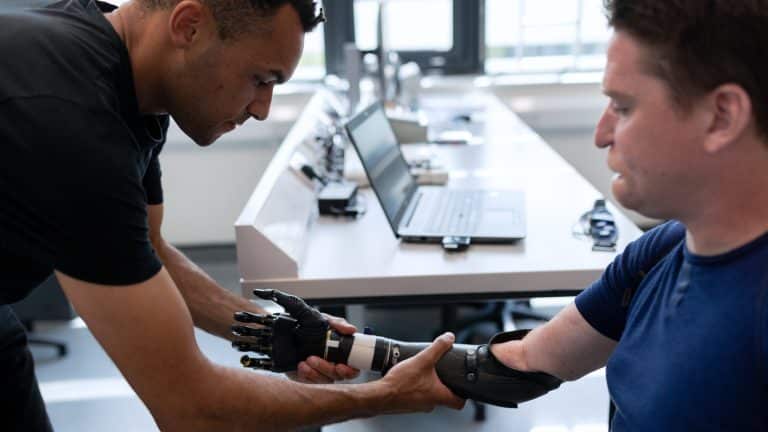

Prosthetics allow individuals with missing limbs to defy limitations. As the science of prosthetics continues to advance, we have been able to create specific types for each person’s unique needs. In this blog, we’ll look at the four primary types of prostheses and how they are utilized.
- What Are The Different Types of Prosthetics?
- What Is The Most Common Prosthesis?
- Which Body Part Is The Most Common To Be Replaced With A Prosthetic?
What Are The Different Types of Prosthetics?
Each type of prosthetic serves a specific function, including the type of limb it replaces and how it is connected to the body. These four types of prosthetics include transradial, transhumeral, transtibial, and transfemoral.
Transradial
A transradial prosthetic is an artificial arm, or upper extremity prosthetic. It attaches directly below the patient’s elbow.
There are two types of transradial prosthetics: Passive and Active.
A passive device is only cosmetic and doesn’t restore function or movement. Active transradial prosthetics are meant to restore function to the missing limb. This can be cable-operated prosthetic devices, which use a harness connected to the shoulder of the missing arm and the other arm to allow the user to control manually (body-powered prostheses).
It may also be a myoelectric prosthetic implant that detects muscle movement in the upper arm using special sensors, allowing the artificial hand and arm to move through these sensors.
Transhumeral
A transhumeral prosthetic arm attaches to the body above the elbow and below the shoulder. Like a transradial prosthetic, transhumeral can be active or passive, but the elbow’s absence can make restoring functionality more challenging.
Active transhumeral prosthetics incorporate myoelectric sensors, and sometimes cables, into the design to allow the user to move their limb like an actual body part.
Transtibial
A transtibial prosthesis is an artificial leg, or lower limb prosthetic, that attaches below the knee of the user. People who need this type of prosthetic have a fully functional knee, which provides plenty of range of motion for the prosthetic. Because of this, the transtibial prosthetic mainly works to distribute weight during movement. One key feature of this prosthetic is that the artificial foot typically doesn’t move, meaning the user will need proper physical rehabilitation to get used to walking differently.
Transfemoral
A transfemoral prosthesis is an artificial leg that attaches above the knee. It has a prosthetic knee joint and a socket connecting the residual limb to the prosthetic leg. Although this type of prosthetic is more challenging than the others due to replacing the knee joint and most of the leg, users can still fully regain their ability to walk and move with proper rehabilitation and training.
What Is The Most Common Prosthesis?
Transtibial prosthetics are the most popular type used for amputees, and a study from 2009 found that these made up 56.1% of artificial limbs. That said, newer studies continue to reflect the same stats.
A 2022 study reported that the most common type of socket used is a patellar tendon-bearing prosthesis designed explicitly for transtibial amputations.
Which Body Part Is The Most Common To Be Replaced With A Prosthetic?
The most common body parts to be replaced with a prosthetic include the lower leg and foot, the leg with the knee, arms above and below the elbow, and hands. Although these may be the most common, prosthetics can be used for multiple body part replacements, including the eyes, arteries, and heart valves.
Get Started On Your First Prosthetic With Pongratz
Pongratz is your one-stop shop for prosthetics and orthotics. Our team of professionals can answer any questions or concerns you may have about the process of receiving and acclimating to life with a prosthetic.
Contact us today to learn more!