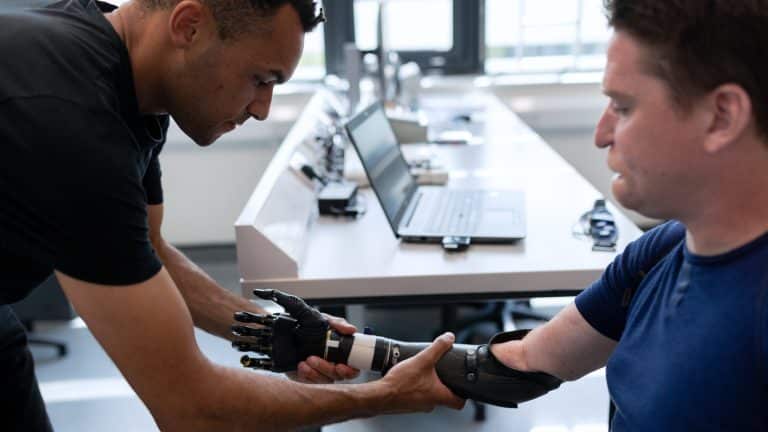

Prosthetics, or artificial limbs, are invaluable in improving the quality of life for individuals experiencing limb loss. Whether you are an adult who needs an artificial limb or a parent seeking the best options for your child, understanding what prosthetics do and the different prosthetic devices can help you make an informed decision that will benefit you for a lifetime.
- What problems do prosthetics solve?
- How do prosthetics work?
- Are prosthetics painful?
- Can prosthetics feel things?
- Do prosthetics make you faster?
- Do people with prosthetics take them off to sleep?
- Can a prosthetic break?
- How long do prosthetics last?
- How hard is it to walk with a prosthetic?
What problems do prosthetics solve?
Prosthetics address several challenges associated with limb loss or impaired limb function.
Artificial body parts are designed to accomplish the following:
- Restore mobility
- Enhance activity levels
- Improve quality of life and well-being
- Increase functional capacity
- Be used as an alternative to reconstructive surgery
- Aid one’s independence and effectiveness in performing daily activities
How do prosthetics work?
Prosthetic limbs, or artificial body parts, work by mimicking the function of natural limbs. They can be categorized into body-powered, motor-powered devices, and myoelectric-powered.
- Body-powered prosthetic limbs use cables and harnesses to control movement
- Motor-powered prosthetics typically have a switch for activation (e.g., a prosthetic hand might have a switch on the wrist to activate a gripping motion)
- Myoelectric-powered prosthetics operate by utilizing electrical signals from the residual limb’s muscles. The electrodes on the skin pick up electrical signals from muscle contractions and interpret them to initiate movements in the prosthetic limb.
There are hybrid prosthetics that combine both body-powered and electrically powered components for better functionality than single-component prosthetics.
Some prosthetics help the upper and lower extremities.
The types of prosthetics are numerous:
- Transfermoral (above the knee)
- Transtibial (above the ankle)
- Syme amputation (at the ankle joint, with the hell pad preserved)
- Foot
- Partial foot
- Toe
- Disarticulation
- Transhumeral (above the elbow)
- Transradial (above the wrist)
- Transcarpal (below the wrist)
Are prosthetics painful?
An occupational therapist and a physical therapist often collaborate to ensure the prosthetic fits well and functions effectively, aiding the user in achieving a good range of motion and comfort. Adjusting to a new prosthetic limb can involve some initial discomfort. However, modern prosthetics are designed to minimize pain and maximize comfort.
Proper fitting and adjustments are crucial throughout the entire process. Soft tissue around the residual limb must be carefully managed to prevent sores and irritation. Regular check-ups with your prosthetist and therapist can help address any issues and ensure a maximally comfortable experience.
Can prosthetics feel things?
While current prosthetics cannot replicate the sensation of touch, advancements are being made in this area. Some experimental prosthetic hands and arms, for example, are becoming equipped with sensors that can provide feedback. This allows the user to feel pressure or texture to a limited extent. These developments strive to make prosthetic devices more intuitive and functional.
Do prosthetics make you faster?
Prosthetics are designed to restore normal function and movement, not necessarily to enhance speed. However, with practice and the right type of prosthetic, users can achieve high levels of performance in various activities they might have felt they would never have been able to partake in.
A prosthetic can help you perform daily activities such as walking, eating, or dressing faster. Specialized prosthetics for sports and high-performance activities can enhance an individual’s ability to participate in athletics and improve their overall physical fitness.
Do people with prosthetics take them off to sleep?
Yes, most people remove their prosthetic limbs or orthotics while sleeping. This helps to prevent unnecessary pressure on the residual limb while sleeping and allows the skin to breathe, rest, and prevent infection. Removing the prosthetic daily also provides an opportunity to inspect the limb for any signs of irritation or damage.
Can a prosthetic break?
Prosthetics, like any mechanical device, can experience wear and tear over time and may require repairs. However, our high-quality prosthetic limbs are built to be durable. Though they are not indestructible, regular maintenance and proper care are essential to extend the life of a prosthetic device. By following the manufacturer’s guidelines and consulting your prosthetist for any necessary repairs, replacements, or adjustments, you will guarantee longevity of use.
How long do prosthetics last?
The lifespan of prosthetics varies depending on the user’s activity levels, the type of prosthetic, and how well they are maintained.
- Upper extremity prosthetics last anywhere from three to five years before needing significant repairs or replacement.
- Lower extremity prosthetics tend to have a shorter life span than upper extremity prosthetics, lasting on average one to three years.
- High-activity prosthetics designed for high-impact activities such as running or sports typically last anywhere from one to three years due to the added stress and wear and tear.
Advances in technology continue to improve the durability and functionality of prosthetic devices.
Can you wear a prosthetic all day?
Yes, many individuals wear their prosthetics throughout the day. However, it is important to monitor the residual limb for signs of discomfort or irritation. Taking periodic breaks and practicing properly goes a long way toward ensuring comfort throughout the day.
How hard is it to walk with a prosthetic?
Walking with a prosthetic leg requires practice and physical therapy like everything else. Initially, it may feel challenging, but with the guidance of a physical therapist, users can learn to walk confidently and comfortably. Modern prosthetics are designed to provide the most stability and support, allowing for a more natural gait and improved mobility.
Quality Prosthetics Custom-Fitted to You at Pongratz
If you or your loved one requires a quality and functional prosthetic device, our team of experienced professionals is dedicated to helping you achieve the best possible outcome.
Our prosthetic services include:
Contact us today to learn more about our services and how our advanced prosthetic solutions can improve your quality of life.